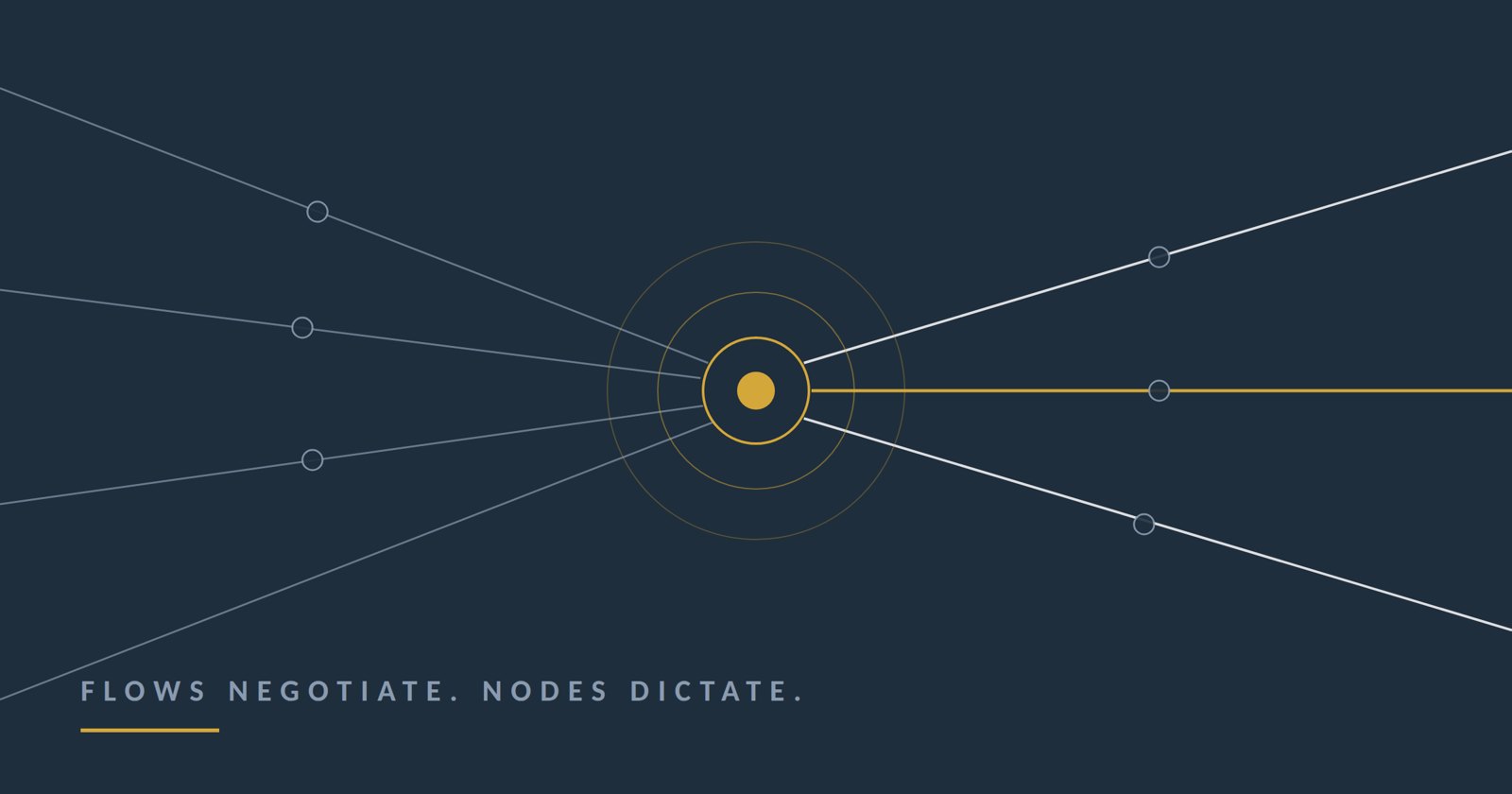
Everyone in Nordic transport is fighting over flows. Volume targets, lane wins, tender rounds: the visible contest, reported quarterly, celebrated in press releases. It is also the less decisive one.
The decisive contest is quieter. It is over nodes: ports, intermodal terminals, marshalling yards, and increasingly the charging and fuelling points that electrified freight will depend on. The fixed places where flows can be held, priced, prioritised, or delayed. Node positions change hands through acquisitions, concession renewals, and terminal agreements that rarely make headlines. By the time the effect shows up in a tender, the position was taken years earlier.
The asymmetry is structural. A flow is contestable: a shipper can reroute, an operator can be swapped, a lane can be rebid next year. A node is not. Its capacity is finite, its location is fixed, and its replacement cycle is measured in decades; permits alone can consume ten years. Whoever controls the node sets the terms for every flow that must pass through it.
This is why margin in a corridor so often pools somewhere other than where the work is done. The operator runs the trains, carries the assets, absorbs the variance, while the node holder prices the bottleneck. Control of the constraint beats ownership of the activity.
Most operator strategy still runs on flow logic: win volume, add lanes, defend share. Meanwhile the node landscape is moving. Terminal concessions are consolidating. Port capacity is being committed to energy and defence uses alongside freight. Electrification is about to create an entirely new class of node, charging capacity, whose owners are being decided now. Strategy that counts lanes but not nodes is measuring the contestable half of the board.
The answer is not owning everything. Full-chain ownership is capital-inefficient, politically impossible in this region, and strategically unnecessary. Node control is selective. Which two or three nodes are your flows genuinely hostage to? What position do you need there? Ownership is one instrument among several; long-term capacity rights, co-investment, or shared governance often buy the same security at a fraction of the capital. And where can you deliberately stay asset-light? Everywhere else, which is most places.
Heavy where it matters. Light where it does not. Structure before scale.
Operating experience says the same from below: in the Green Cargo transformation, network performance was won or lost at specific yards and interfaces; the +4.5% punctuality and roughly 130 MSEK of structural EBIT were, in large part, node effects. So the diagnostic is one exercise: name the nodes that could hold your business to ransom in five years: by name, with the exposure quantified. Then ask what position you hold there today, and who else is building one.
If the answer is a blank page, the contest is already underway, without you at the table.